Cambridge International · IGCSE · English Literature
Things Fall Apart
Chinua Achebe's 'Things Fall Apart' is a profound and tragic exploration of pre-colonial Igbo society and the devastating impact of British colonialism. Studying this novel offers a unique opportunity to engage with rich oral traditions and complex characters while challenging historical narratives, making it a highly rewarding text for IGCSE Literature.
- 9 min read
- 2 worked examples
- 4 practice questions
- 8 key terms
Study Notes
Overview
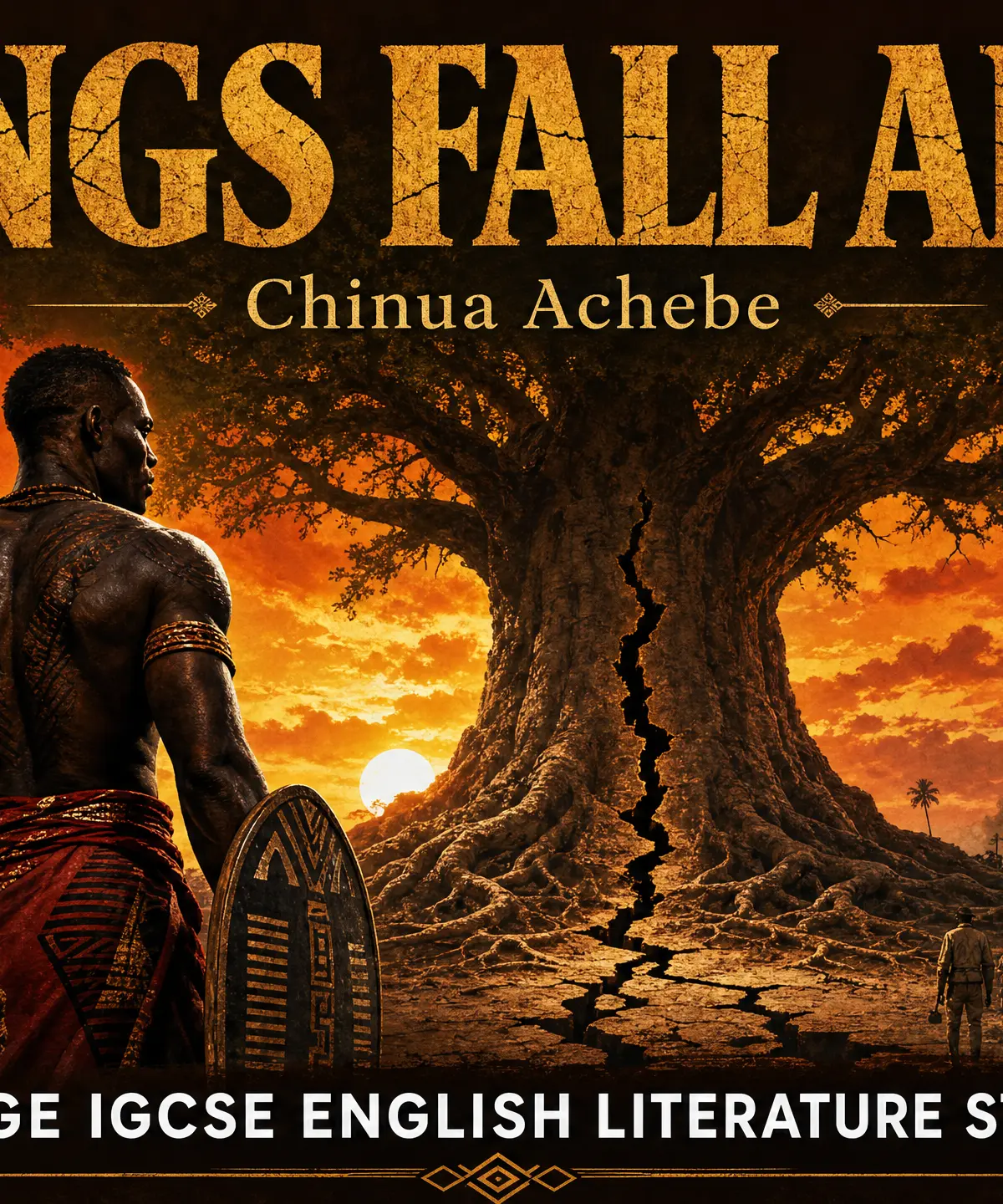
'Things Fall Apart' (1958) is arguably the most important African novel in English. Chinua Achebe wrote it to reclaim the narrative of Africa from Western writers like Joseph Conrad, who depicted the continent as a dark, voiceless savage land. Set in the late 19th century in the fictional Igbo village of Umuofia, Nigeria, the novel chronicles the tragic downfall of its protagonist, Okonkwo, alongside the disintegration of his society under the pressures of British colonialism and Christian missionary activity. For Cambridge IGCSE, examiners reward candidates who can move beyond simple plot retelling to analyse how Achebe constructs this complex society, why he uses specific linguistic devices (like proverbs), and the nuanced ways he presents the collision of cultures without reducing characters to mere stereotypes.
Plot/Content Overview
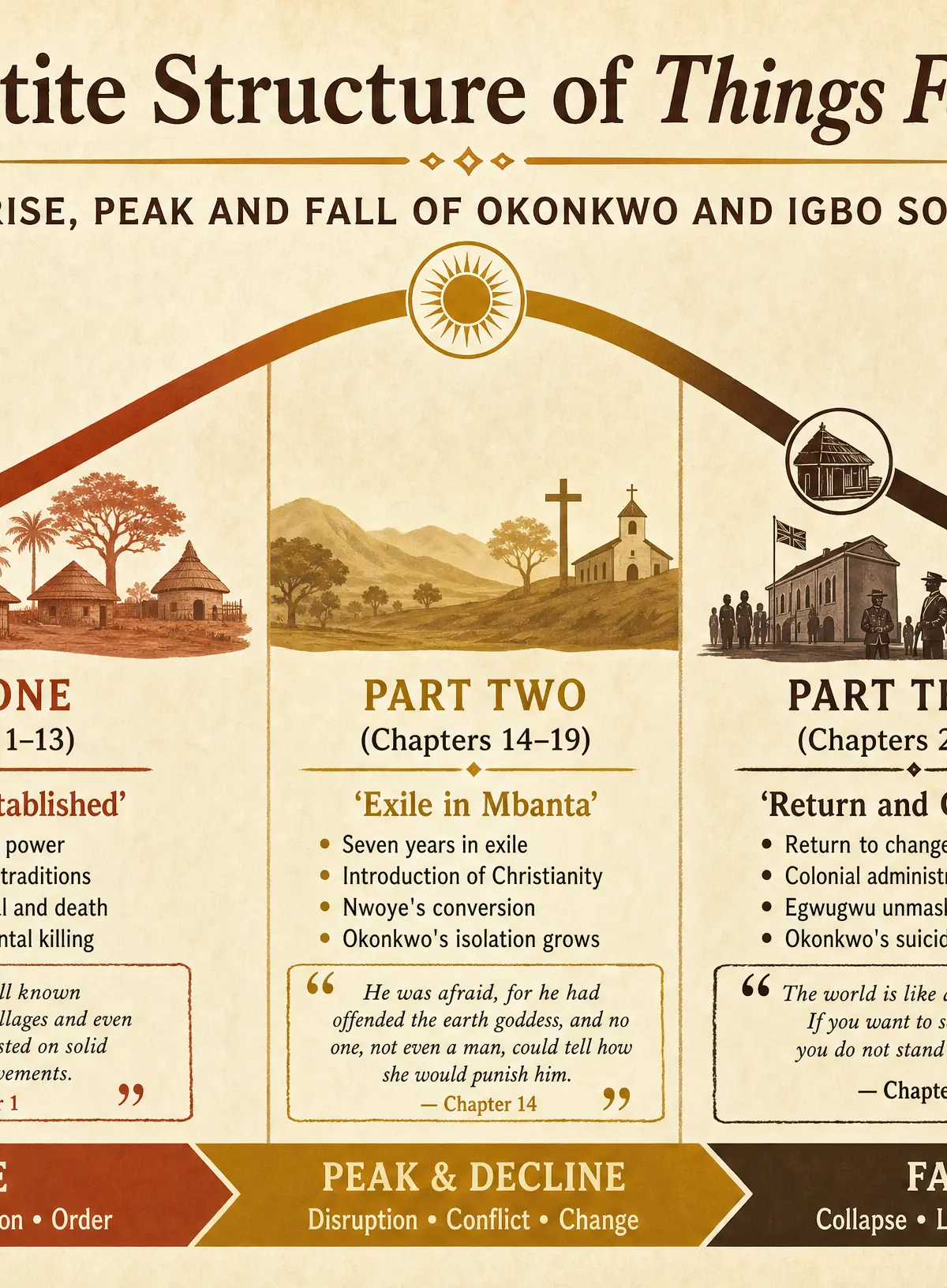
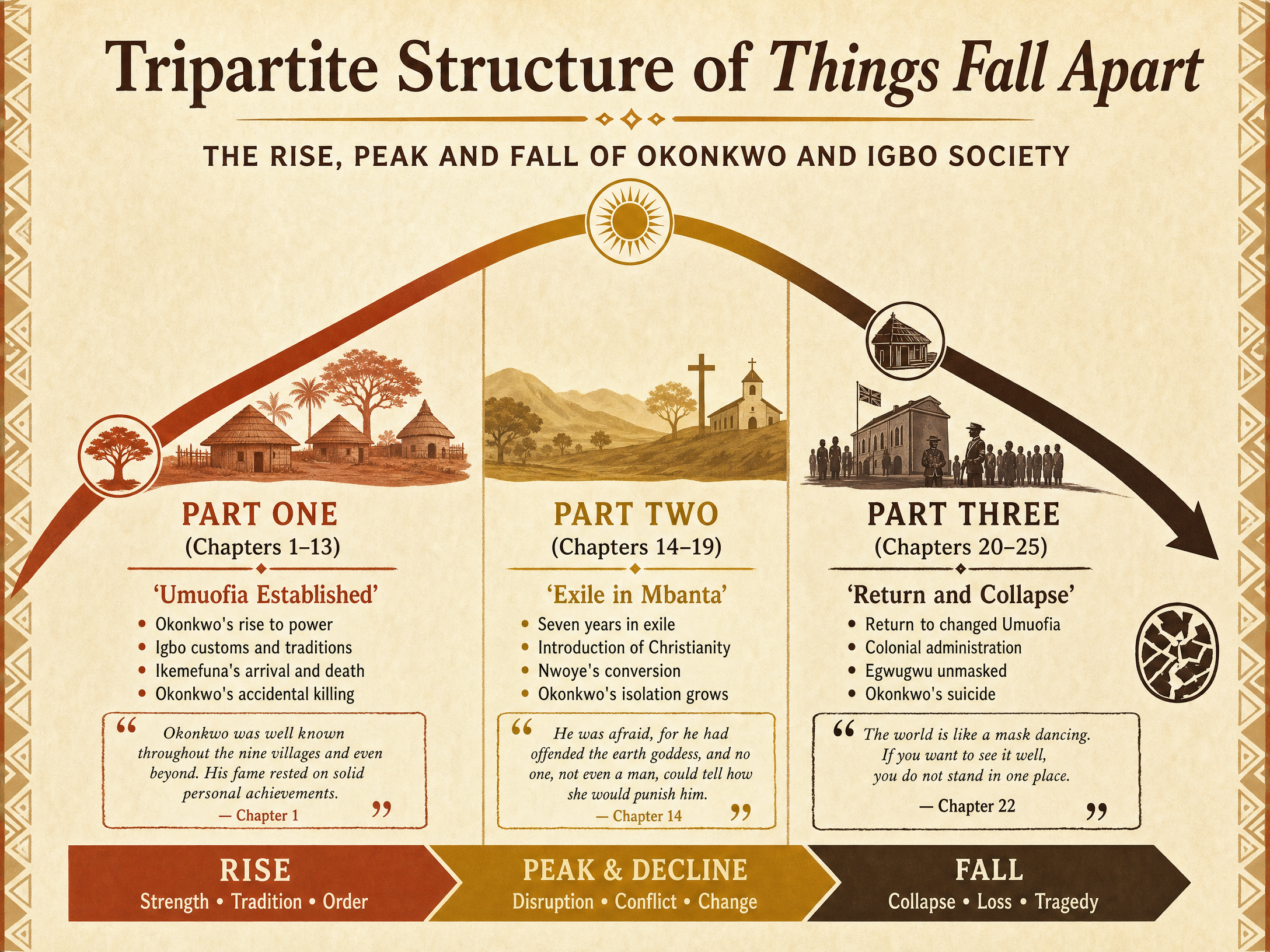
**Part One: Umuofia Established (Chapters 1-13)**The novel establishes the rich, complex society of Umuofia. We are introduced to Okonkwo, a respected warrior and farmer whose entire life is driven by a fear of failure—specifically, the fear of resembling his lazy, debtor father, Unoka. Okonkwo's rigid masculinity leads him to participate in the ritual killing of his surrogate son, Ikemefuna, a turning point that fractures his family, particularly alienating his biological son, Nwoye. Part One ends with tragedy: Okonkwo's gun accidentally explodes at a funeral, killing a clansman. He is exiled to his motherland, Mbanta, for seven years.
**Part Two: Exile in Mbanta (Chapters 14-19)**During Okonkwo's exile, the British arrive in Umuofia and Mbanta. They bring a new religion (Christianity), a new government, and a new economic system. The missionaries, initially led by the tolerant Mr Brown, appeal to the outcasts and marginalized members of Igbo society. Crucially, Nwoye converts, causing a permanent rupture with Okonkwo. The 'things that held us together' begin to loosen.
**Part Three: Return and Collapse (Chapters 20-25)**Okonkwo returns to Umuofia to find it irrevocably changed. The aggressive Reverend Smith replaces Mr Brown, exacerbating tensions. When a zealous convert unmasks an egwugwu (ancestral spirit), the clan destroys the church. In retaliation, the District Commissioner deceitfully imprisons and humiliates Umuofia's leaders, including Okonkwo. Upon release, Okonkwo kills a colonial messenger, hoping to spark a war. Realizing his clan will not fight, he hangs himself—an abomination in Igbo culture. The novel ends chillingly from the perspective of the District Commissioner, who plans to write a book reducing Okonkwo's tragic life to a mere paragraph.
Themes
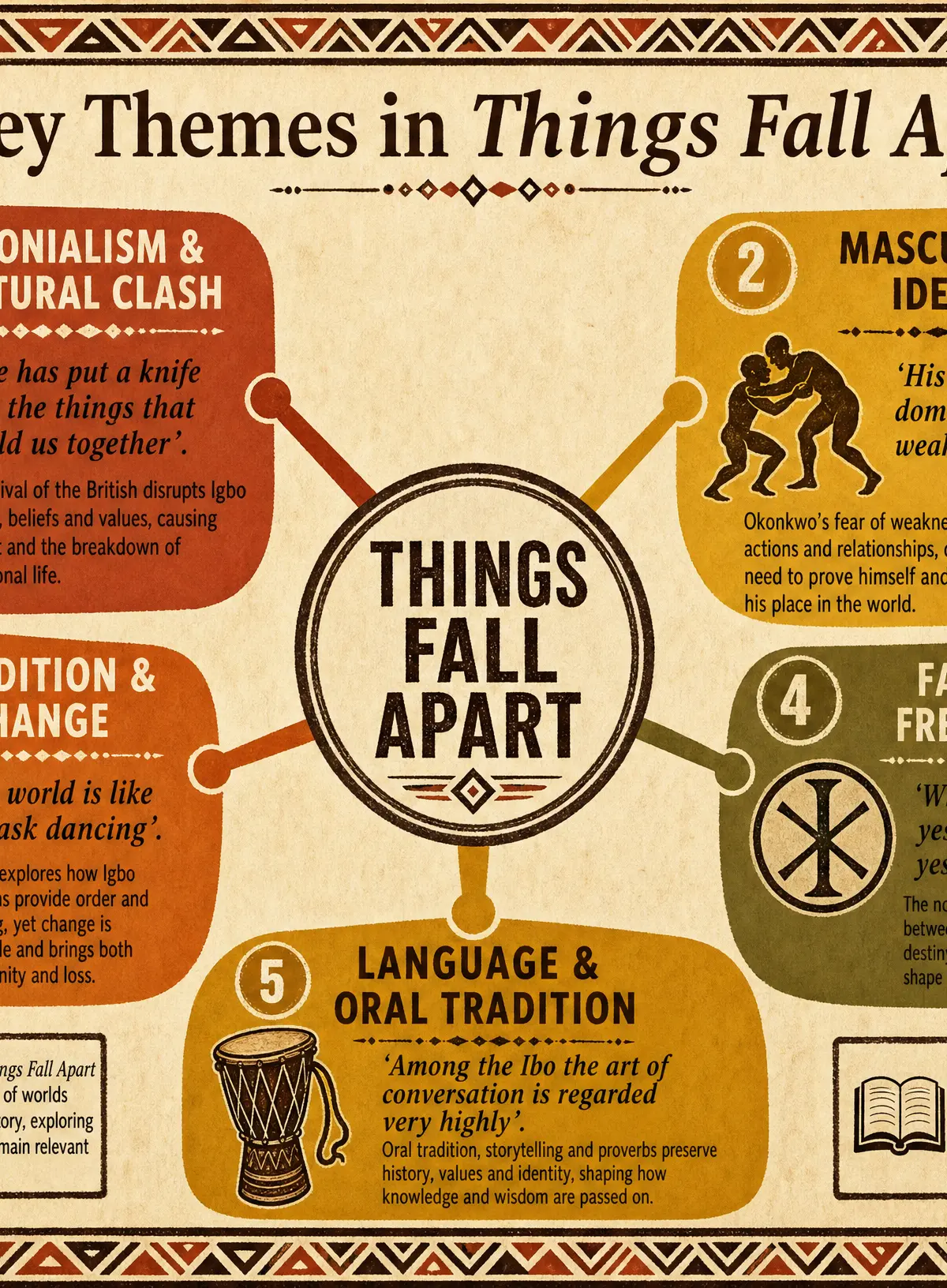
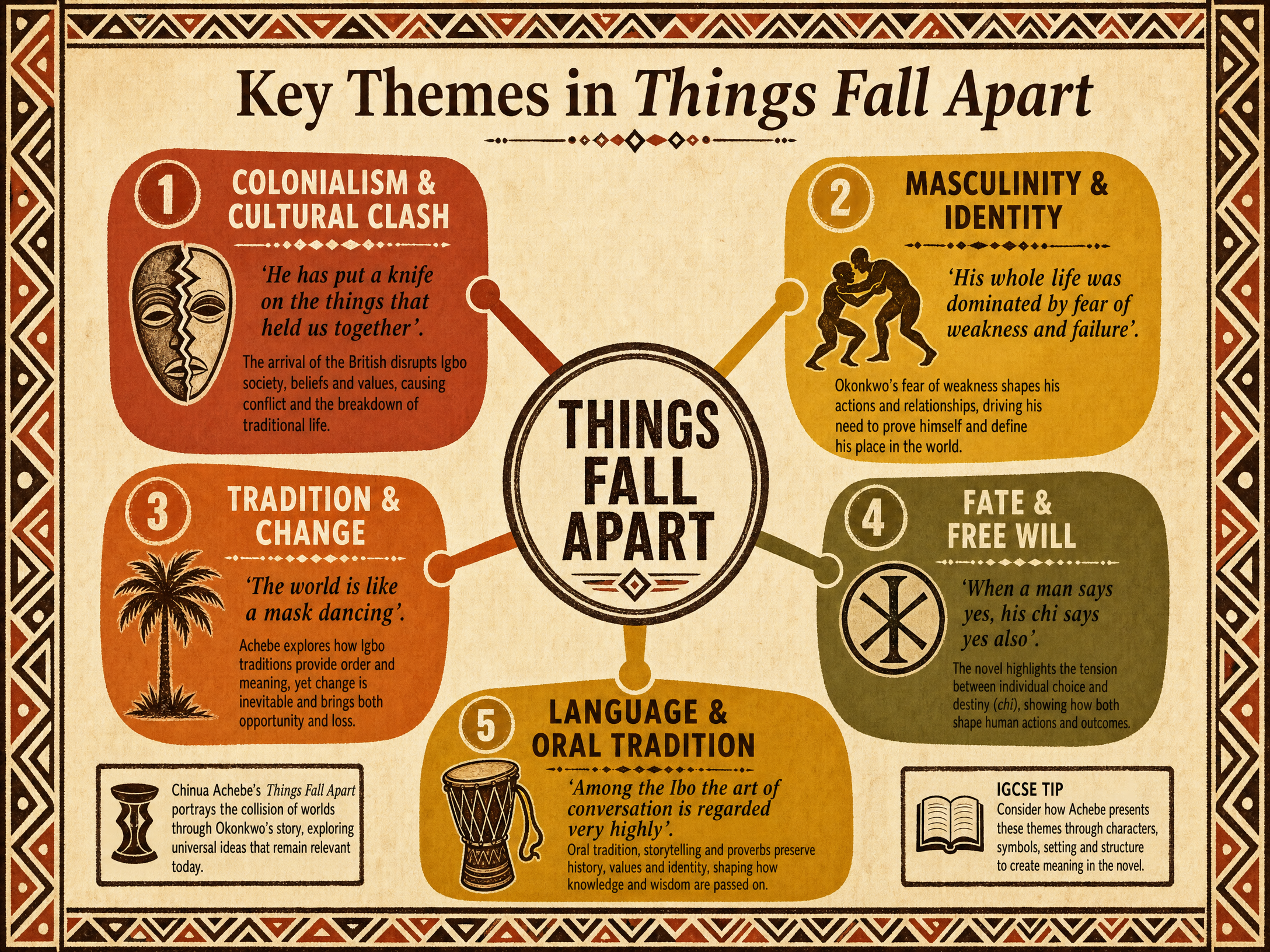
Theme 1: Colonialism and Cultural Clash
Achebe meticulously details the multifaceted impact of British colonial intervention. He does not present a simplistic 'good vs. evil' narrative; rather, he shows how the colonial administration systematically dismantled the spiritual, economic, and communal life of Umuofia. The tragedy lies in the total incomprehension between the two cultures.
Key Quotes:
- "He has put a knife on the things that held us together and we have fallen apart." (Chapter 20) - Obierika's profound realization of the permanent damage inflicted by the colonizers. The metaphor of the 'knife' suggests violent, deliberate severance of communal bonds.
- "The white man is very clever. He came quietly and peaceably with his religion." (Chapter 20) - Highlights the insidious, gradual nature of the colonial takeover, contrasting with Okonkwo's preference for direct, physical confrontation.
Theme 2: Masculinity and Identity
Okonkwo's tragic flaw is his rigid, toxic interpretation of masculinity. He equates emotion with weakness and violence with strength. This internal conflict drives the plot and ultimately isolates him from his family and his changing society.
Key Quotes:
- "His whole life was dominated by fear, the fear of failure and of weakness." (Chapter 2) - The psychological engine of the novel. Achebe establishes Okonkwo's motivation early, framing his later violent actions as stemming from internal terror rather than genuine strength.
- "Dazed with fear, Okonkwo drew his matchet and cut him down. He was afraid of being thought weak." (Chapter 7) - The killing of Ikemefuna. The repetition of 'fear' emphasizes that Okonkwo's adherence to a brutal masculine ideal overrides his natural human affection.
Theme 3: Tradition vs. Change
Achebe explores how Igbo traditions provide order and meaning, yet demonstrates that change is inevitable. The novel contrasts characters who cannot adapt (Okonkwo) with those who can (Obierika), suggesting that survival requires flexibility.
Key Quotes:
- "The world is like a Mask dancing. If you want to see it well you do not stand in one place." (Chapter 22) - An Igbo proverb highlighting the necessity of shifting perspectives and adapting to change, a philosophy Okonkwo tragically fails to grasp.
Character Analysis
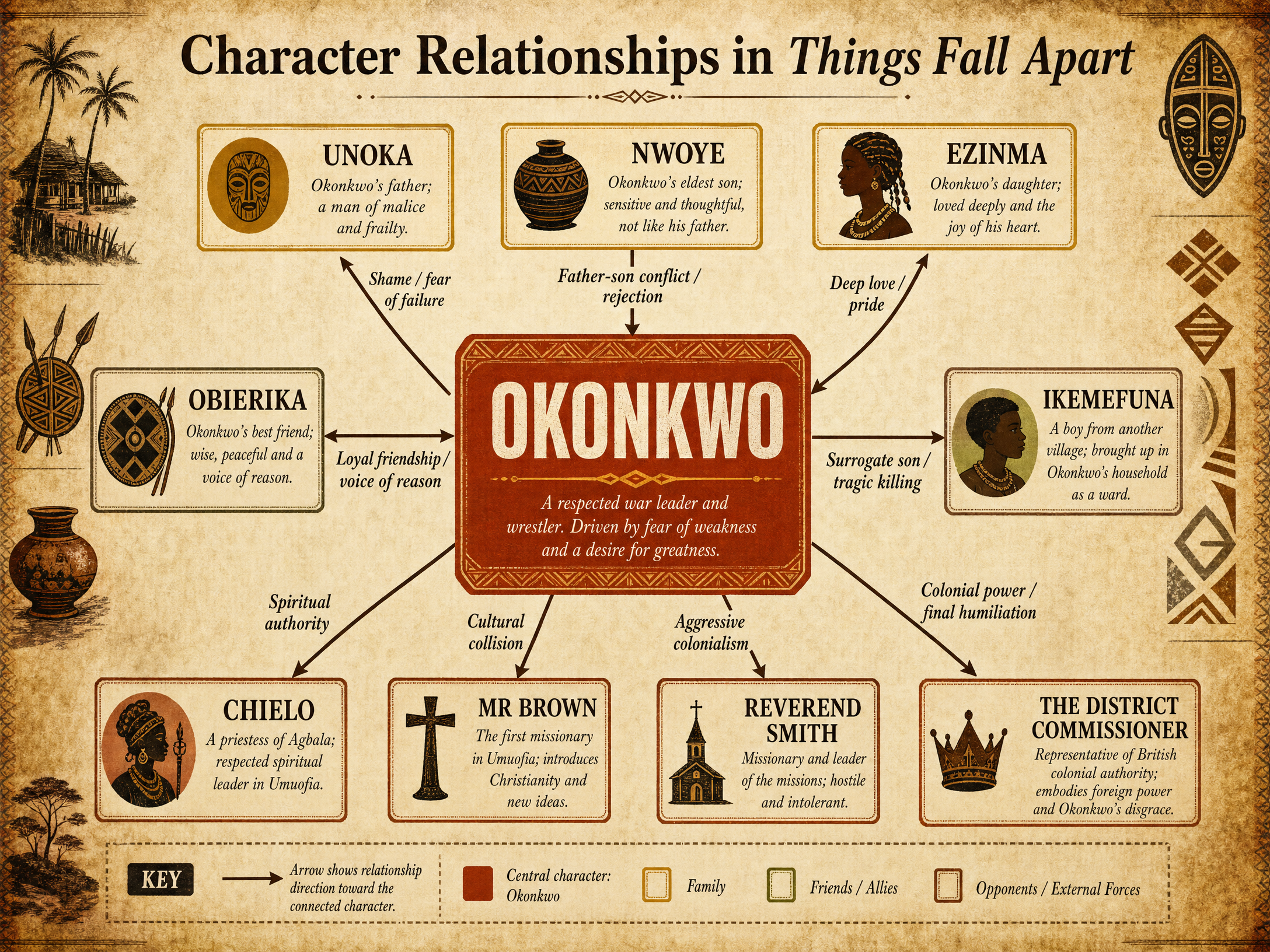
Okonkwo
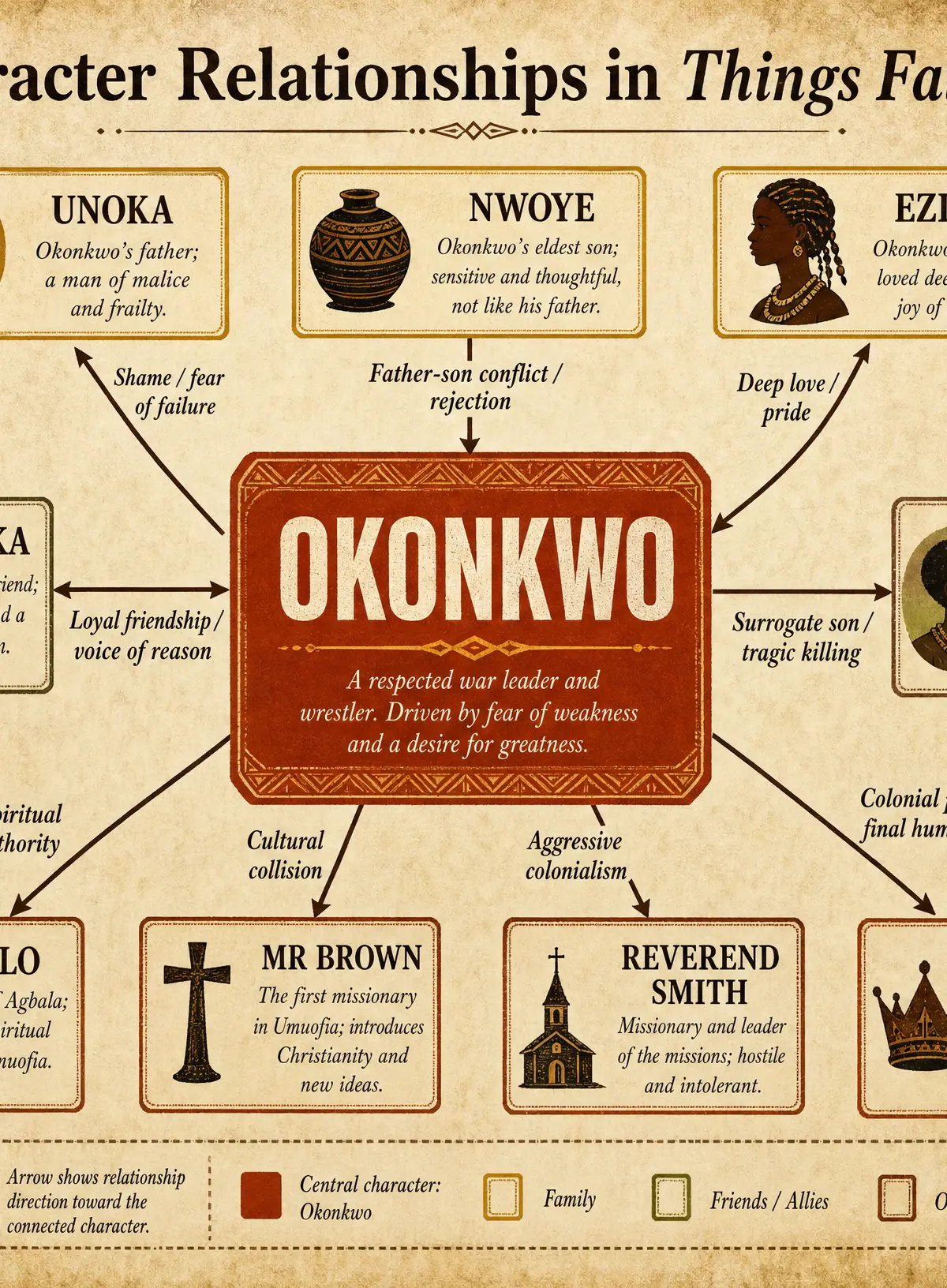
Role: The tragic protagonist; a respected leader whose fatal flaws mirror the vulnerabilities of his society.
Key Traits: Proud, violent, hardworking, emotionally repressed, inflexible.
Character Arc: Rises from poverty to greatness through sheer will; alienates his family through rigid adherence to his masculine ideal; is exiled; returns to find his world changed; chooses suicide over submission.
Essential Quotes:
- "Okonkwo was well known throughout the nine villages and even beyond. His fame rested on solid personal achievements." (Chapter 1)
- "He had no patience with unsuccessful men. He had had no patience with his father."
Obierika
Role: Okonkwo's best friend and a foil to the protagonist; the voice of reason and reflection in Umuofia.
Key Traits: Thoughtful, loyal, questioning, adaptable.
Character Arc: Remains a steady presence; questions the harsher aspects of Igbo tradition (like the disposal of twins); recognizes the irreversible damage of colonialism; delivers Okonkwo's eulogy.
Essential Quotes:
- "Why should a man suffer so grievously for an offense he had committed inadvertently?" (Chapter 13)
- "That man was one of the greatest men in Umuofia. You drove him to kill himself; and now he will be buried like a dog..." (Chapter 25)
Nwoye
Role: Okonkwo's eldest son; represents the internal fracturing of Igbo society and the appeal of the new religion.
Key Traits: Sensitive, questioning, traumatized, seeking belonging.
Character Arc: Struggles under his father's harsh expectations; is deeply traumatized by Ikemefuna's death and the abandonment of twins; finds solace in the poetry of Christianity; changes his name to Isaac, fully assimilating into the colonial structure.
Essential Quotes:
- "It was the poetry of the new religion, something felt in the marrow. The hymn about brothers who sat in darkness and in fear seemed to answer a vague and persistent question that haunted his young soul..." (Chapter 16)
Writer's Methods
Proverbs and Oral Tradition: Achebe famously writes, "Among the Ibo the art of conversation is regarded very highly, and proverbs are the palm-oil with which words are eaten." Examiners heavily reward analysis of these proverbs. They are not merely decorative; they structure the narrative, provide cultural validation, and demonstrate the philosophical depth of Igbo society.
Narrative Voice: Achebe employs a third-person omniscient narrator that often adopts the tone and rhythms of an Igbo storyteller (a griot). This creates a sense of communal history and positions the reader inside the culture before the colonizers arrive.
Tragic Structure: The novel follows a classical Aristotelian tragic arc. Okonkwo is a man of high standing brought low by a hamartia (fatal flaw)—his fear of weakness. The tripartite structure (Rise, Exile, Collapse) mirrors both Okonkwo's personal trajectory and the fate of Umuofia.
Foreshadowing: Achebe frequently uses foreshadowing to build a sense of inevitable doom. The early mention of Ikemefuna as a "doomed lad" and Okonkwo's constant anxiety about Nwoye's softness prepare the reader for the eventual tragedies.
Context
Postcolonial Literature: Published in 1958, two years before Nigeria gained independence, the novel is a foundational postcolonial text. Achebe wrote it to counter European narratives (like Heart of Darkness) that depicted Africans as savages without history or language.
Igbo Society: Achebe presents a pre-colonial society that is not a utopia, but a complex, functioning civilization with its own justice system, religion, and social hierarchy. Understanding this is crucial for AO3 (Context). The tragedy is not just the arrival of the British, but the destruction of a sophisticated culture.
The Title: The title is drawn from W.B. Yeats's poem The Second Coming: "Things fall apart; the centre cannot hold; / Mere anarchy is loosed upon the world." Achebe's use of a canonical Western poem to title an African novel is a deliberate act of literary reclamation, suggesting that the 'anarchy' was brought by the colonizers, not inherent to Africa.
Podcast Episode
Listen to our comprehensive 10-minute podcast episode covering core concepts, themes, and examiner tips for 'Things Fall Apart':

A full transcript of this podcast is available in your study materials.
Visual Resources
3 diagrams and illustrations
Interactive Diagrams
1 interactive diagram to visualise key concepts
Conceptual Flow Outline
The Causal Chain of Okonkwo's Tragic Downfall
Worked Examples
2 worked examples — open one to explore the question and available guidance.
Practice Questions
Test your understanding — click to reveal model answers
Explore how Achebe presents the relationship between fathers and sons in Things Fall Apart.
Hint: Consider the chain of generational rejection: Okonkwo rejects Unoka, and Nwoye ultimately rejects Okonkwo. Look at Ikemefuna as the ideal surrogate son.
How does Achebe use the character of Obierika to highlight Okonkwo's flaws?
Hint: Obierika is a foil. Compare how they react to the Oracle's decree about Ikemefuna, and how they view the arrival of the white men.
Explore the significance of religion and the supernatural in the novel.
Hint: Don't just write about Christianity. Start with the Igbo religion (Chielo, the Oracle, the egwugwu) to show what was lost.
How does Achebe present the role of women in Umuofia?
Hint: Look beyond Okonkwo's wives. Consider Chielo (the priestess) and the concept of 'Nneka' (Mother is Supreme).